September 18th 2026
Restaurant De Tippe: a good match starts with a fair chance
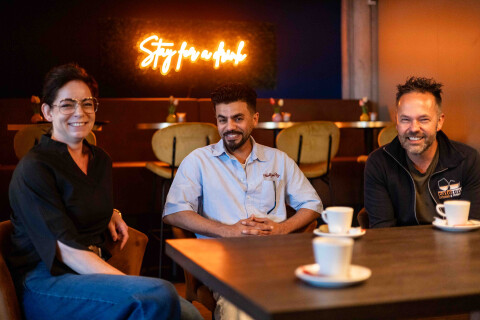
Hiring a new colleague who does not yet speak the language fluently and comes from a different work culture requires extra attention. In this story, produced by RefugeeWork, Jeroen and Heleen, owners of Restaurant De Tippe in Vledder, share what they believe is ultimately most important: does someone fit the team?
RefugeeWork is the online platform where employers and newcomers find each other. As part of Refugee Talent Hub, RefugeeWork contributes to a Netherlands where employers recognize and utilize the talents of refugees, and where refugees therefore have the right opportunities in the labor market.
Jeroen and Heleen have been running Restaurant De Tippe in Vledder since 2007. Together, they built up the restaurant with much love and passion. Over the years, De Tippe grew significantly. Catering was added in 2020, and there is now also a second location in Steenwijk.
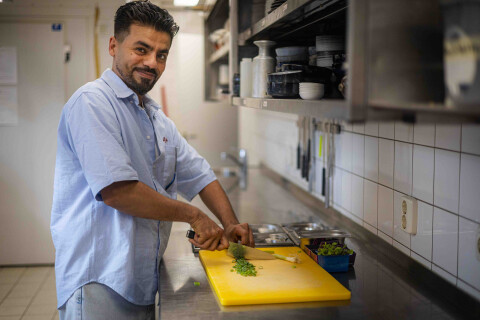
With that growth, new vacancies arise regularly. When Lisan Doorten, Account Manager Work & Income at the Municipality of Westerveld, saw a vacancy for a cook at De Tippe, she thought of Waled. Waled was eager to start working as a cook, and De Tippe was looking for one. Lisan contacted the restaurant: “I have a cook for you.”
An intermediary makes everything easier and clearer.
Waled is 33 years old and comes from Yemen. He previously worked in various countries and in the hospitality industry. In Westerveld, he followed a civic integration program. Finding work on his own was a natural choice for him, but previous jobs ended in disappointment. Lisan remained involved: she encouraged him, but also held up a mirror to him. Eventually, Waled accepted her help as an intermediary. That made a big difference. Waled: “I have learned that help from an intermediary is very valuable. It makes everything easier and clearer.”
Jeroen and Heleen looked at his experience as a chef and the business side. But the personal connection was at least as important. Jeroen: “Someone can be ever so good at their profession, but if they don't fit into the team, it becomes difficult. That applies to every new colleague, by the way, with or without a refugee background.”
And so Jeroen spoke with Waled for an introduction. Waled was visibly nervous, but Jeroen got a good feeling nonetheless: “I actually felt a good connection right away. So I thought: yes, I believe in this.” A trial day confirmed that feeling. De Tippe decided to proceed with Waled.
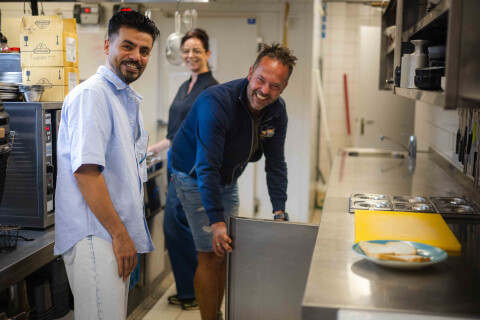
Just because the match felt right didn't mean everything went smoothly from day one.
Waled still had to take civic integration exams during the same period. That cost him a lot of time and energy. Even during his shifts, he wasn't always fully focused on his work. Things went wrong occasionally. That was difficult for his colleagues in the kitchen. They wondered: is this actually going to work?
The start was intense for Waled as well. He was confronted with many new words, dishes, and working methods. In a kitchen, the pace is high, and you have to be able to switch gears quickly. At the same time, he was still busy mastering both the language and the working methods of his new workplace.
Nevertheless, he was given the space to learn. For instance, he took photos of dishes to remember how they should be plated. Jeroen and Heleen continued to talk to him and gave him the chance to improve. Waled: “That gave me a sense of calm. They saw the mistakes I made. But they said: come on, we’ll keep going. They trusted me and gave me time.”
That trust proved important. A lot changed after his exams. The pressure was gone, and Waled could focus fully on his work. Colleagues also noticed that he was making rapid progress. Midway through the season, he knew exactly what was expected of him. Since then, he has been running his part of the kitchen independently.
The initial period therefore required extra attention. But precisely because that space was available, more and more calm and trust emerged.
Language barrier? Turn it into a shared challenge
Language was also a point of attention in the beginning. Waled spoke good English, but his Dutch was still very much developing. At the same time, there were colleagues in the kitchen who did not speak English themselves. That sometimes made it difficult to understand each other quickly, especially during busy times.
However, language did not become a reason to make collaboration more difficult. English was spoken increasingly often in the kitchen, and colleagues helped each other to understand one another better. Waled learned more and more Dutch, and colleagues, in turn, picked up English, and even Arabic words from him.
And so, the language barrier became not just something Waled had to learn to deal with. It became something the entire team found a way through.
According to Heleen, it starts with the employer's attitude: “In the beginning, we need to be enthusiastic. And we are. Just genuinely enthusiastic. And then the rest pick up on that.” According to her, that enthusiasm isn't found in an extensive program or a complicated approach. It lies precisely in the daily things: making jokes together, helping each other, and being curious about each other's backgrounds. Heleen: “That attitude creates space to learn from each other. And language becomes less and less of a barrier and more and more something you find your way with together.”
Belonging is in the little things
For De Tippe, becoming part of the team is therefore not something you arrange with an introduction on the first day of work. It is mainly about the moments that follow.
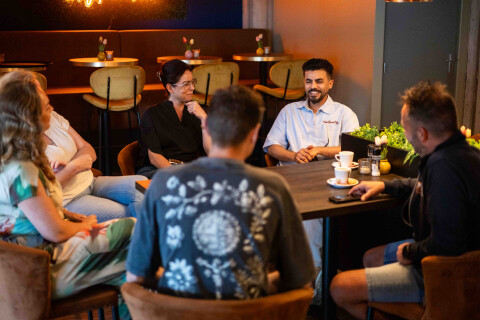
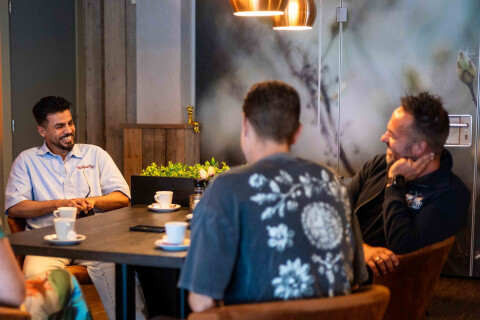
Heleen gives a simple example. When the team is sitting outside after work, colleagues move over as soon as Waled approaches. Space is literally made for him.
To Heleen, that means a lot. “He just belongs. He is one of the team.”
According to her, it is precisely such small moments that make the difference. Especially when someone finds themselves in an environment where a lot of Dutch is spoken and colleagues communicate quickly with each other.
That is why Heleen also considers it important that not only the new colleague adapts. Existing colleagues must also understand what a language barrier means, for example. They see that someone is struggling with the language, but do not always realize how much extra effort it takes to follow a conversation, understand instructions, or respond quickly.
Heleen: “He is joining *our* team. So it is logical that we also take a step towards him. Waled has to adapt to an entire team. We only have to adapt to one person.”
Wees open-minded
Advice for other employers? Jeroen is clear about this: anyone hiring a colleague who still needs to get used to the Dutch language or work culture must be prepared to invest extra time and energy. Jeroen: “And you have to be open-minded. And be aware that you are going to run into a barrier and a hurdle in the beginning.”
Therefore, an employer should not expect everything to run smoothly immediately. The main question is: is someone willing to learn, is someone willing to commit, and can they find common ground?
At the same time, Jeroen remains level-headed. Sometimes a collaboration ultimately turns out not to work. Even then, you have to be able to say goodbye. Not every candidate fits every team.
According to him, therefore, the lesson is not that every collaboration must succeed. The lesson is that you do have to give someone a fair chance.
Look beyond day one
De Tippe's story shows that working with a new colleague who does not yet speak Dutch fluently is not about erasing all differences.
Language, civic integration, work experience, and differences in work culture may require extra attention in the beginning. That is part of the start. The more important question is whether employer and employee are willing to go through that initial period together.
There is a concrete lesson in this for employers: don't just look at what someone can do on day one. Also look at motivation, the personal chemistry, and the place someone can take in the team.
Give someone the freedom to learn and involve colleagues in that development. Be clear about what you expect and ask what someone needs to do the job well. Where necessary, use an intermediary like Lisan, who knows both sides.
Because a good match doesn't have to be perfect on the first day of work. At De Tippe, that match actually grew stronger because Jeroen, Heleen, Waled, and his colleagues gave each other the time and trust to get used to it, learn from each other, and move forward together.
And sometimes a good collaboration simply begins with the question: shall we give it a try?