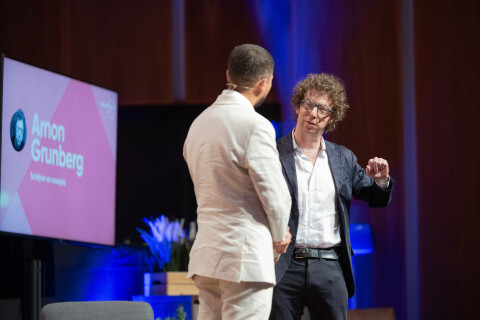
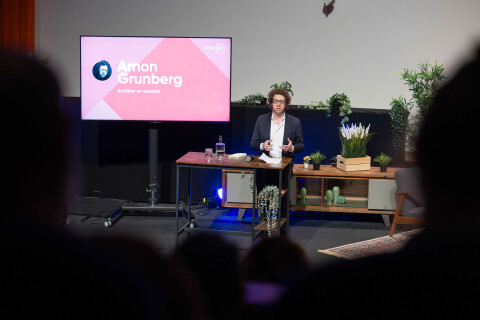
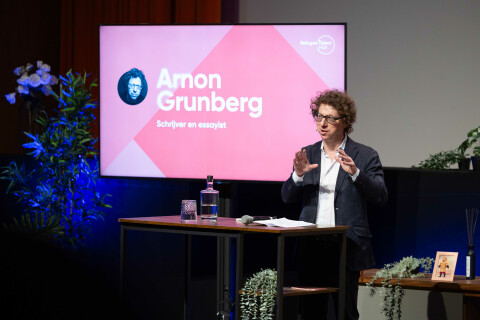
Arnon Grunberg was one of the keynote speakers at our public event on June 20, 2024. He spoke about fiction and other realities, and in doing so, got us all thinking.
Why is a small village in the desert in the American state of Arizona, about a half-hour drive from the Mexican border. Two major traffic arteries once converged there in the shape of a Y, which is why the villagers wanted to name their village Y, but Arizona law dictates that village or town names must have at least three letters. Thus, it became Why, a fitting name for a village where life revolves around the nearby border crossing, which closed for a few months six months ago because hundreds of migrants began setting up tents along the border wall, as reported by The New York Times. The border post is actually called Lukeville, a tiny community according to the same newspaper, consisting of a few duty-free shops and a motel.
The official reason for the closure of the border post was that the border guards had to focus on 'the wave of illegal border crossings'; presumably, this wave left them no time to process legal border crossings. Illegal and legal border crossings are not by definition communicating vessels. Shoplifting does not disappear if you drastically lower product prices either; think of sweets at Etos. However, it is true that migration is also a market and, as such, is not exempt from the laws of the market.
Fiction accepted as truth has an enormous influence on reality.
Arnon Grunberg
The main driver of migration is our need for cheap and, nowadays, also less cheap labor. Hein de Haas rightly emphasizes this in his book *How Migration Really Works*. Earlier this year, a report by the Central Planning Bureau stated it at least as unequivocally. As for the refugees—and there is a disproportionately large amount of talk about them—their number is relatively small. Wars always produce extra refugees—Ukraine, Syria, Yugoslavia—but since 1945, when millions of refugees, not least German refugees, traveled through Europe out of necessity to try their luck elsewhere, things have actually become relatively quiet in Europe regarding refugees.
This stands in such contrast to the problematization of the refugee that anyone following the discourse even slightly begins to think their ears are deceiving them. What we should therefore be discussing is perception versus fact, myth versus reality. The problem is, to begin with, that fiction accepted as true has an enormous influence on reality. You could say that we are dying of fiction, were it not that this is a bit curious for someone who considers himself primarily a novelist. And admittedly, sometimes fiction also has a salvific function, or fiction reveals a truth that has escaped the scientist, who must adhere to stricter rules. By way of illustration: a few weeks ago, I gave a lecture to civil servants at the Ministry of Justice and Security who deal with migration. One of the civil servants asked me a question about perception versus reality. She said: 'Every so often, I publish figures on troublemakers among asylum seekers that always show that the situation with those troublemakers isn't nearly as bad as it seems, but it doesn't sink in. What am I doing wrong?' I replied: 'You are not doing anything wrong. But if De Telegraaf publishes a photo on the front page of an incident involving an asylum-seeking troublemaker, all your factual material can be thrown in the trash. This is how it works.'
Open borders are a utopia; there will always be borders. The question is how we shape those borders.
Arnon Grunberg
It was the German philosopher Hanno Sauer who wrote in his book on morality that it is senseless and counterproductive to make believers of any kind abandon their faith using factual material. The more outrageous the assertion, the more stubbornly the believers cling to it. It is this outrage that enables believers to form a community. Or to put it even more simply: the idea that people are reasonable and rational constantly, or even most of the time, is not supported by facts.
Behind our fictions and myths lurks yet another reality, namely that of the refugee himself, who, for example, comes to a standstill in an American border village and thereby, unintentionally, brings the border village to a standstill. There is also something to be said about that reality. There is a demand for labor, but there is also a demand for fleeing, although, as mentioned, that demand is considerably smaller than the demand for labor; fleeing is expensive, sometimes very expensive, and furthermore risky, often life-threatening. The reasons for fleeing are diverse. But to live as a recognized refugee, one must prove that one's life is no longer safe in one's own country.
You can already picture the perverse incentives. The task of the various naturalization and migration services worldwide is to assess the necessity and credibility of the refugee applying for asylum. In doing so, they try to bring order to the grey zone of the refugee system; it is an attempt to draw the national border through the tent camp as fairly as possible, in Lukeville or elsewhere, but selection remains difficult. Who is welcome and who is not, and why. The inside must be separated from the outside. The strange from the familiar. Open borders are a utopia; there will always be borders. The question is how we shape those borders. How porous must our borders be? That question is multifaceted and presumably also contradictory. How porous must a border be before it ceases to be a border? The question implies a degree of control that may be an illusion.
We are the center; let the sinners rot in the periphery. That is roughly the Western mentality.
Arnon Grunberg
In the Middle Ages, many cities were locked up at night; banishment from the city was considered in some cases an acceptable, albeit gruesome, punishment. We are the center; in the periphery, the sinners may rot away. That is roughly the Western mentality, a mentality I would prefer not to call colonial or postcolonial, if only because those words are accusation and judgment combined, and thus do not initiate a conversation but herald its end. The phrases 'grip on migration,' frequently heard during election campaigns, are a symptom of that mentality. For what exactly needs to be gripped? The fact that some people drew a slightly less favorable ticket in the birth lottery and received a non-Western passport? You could say that lottery chance is full of absurdity, but there is no end to the absurdities, certainly not for the asylum seeker who has to struggle through a jungle of such absurdities—sometimes well-intentioned absurdities—to get in. The waiting is just one of many absurdities. Whether the foreigner is in Lukeville or in Ter Apel, he waits, although I admit that waiting times can vary, and in some countries he is allowed to work a little, which presumably makes time seem to pass a bit faster. According to the IND, the asylum procedure takes 9 months to a year. In America, waiting times are up to 10 years. The Economist, not exactly a left-wing magazine, wrote that as a refugee you have two options: they take advantage of you, or they take advantage of you severely.
Mind you, the weekly magazine was referring to the American government, but I believe something similar can be said about European governments. The asylum bureaucracy we are discussing has the troublesome consequence that asylum seekers must be stored in so-called asylum centers while they wait. The word 'stored' was chosen deliberately. Even after they have been granted status—in other words, after the necessity of their migration has been acknowledged—some asylum seekers must continue to be stored because there are no houses available. According to a recent study, this housing shortage is caused by elderly Dutch people staying in their own homes longer because they cannot or do not want to be stored in a nursing home. Johan Conijn, Professor of Housing Market at the University of Amsterdam, counters that all problems can simply be traced back to 'the fact that we are unable to build more'. A great deal can lie behind the words 'unable'. Whatever the causes, the inflow and outflow to and from the various human storage locations is becoming clogged. These bottlenecks are attributed by some politicians – and we may assume that their voters agree with them – to the arrival of the foreigner. Remove the foreigner from the system, and everyone can be stored again. However, there is no evidence for this.
It is not so much the foreigner who needs our country, it is we who need the foreigner.
Arnon Grunberg
I am inclined to say that the opposite is the case. It is not so much the foreigner who needs our country; it is we who need the foreigner. Granted, one of the informateurs said in an interview that migration solves nothing, but as already pointed out, migration certainly contributes to temporary solutions. And as long as we have not achieved immortality, all solutions are temporary. German Chancellor Scholz announced six months ago that Germany needs tens of thousands of migrant workers to keep the economy running, knowing that an entire generation of Germans will soon retire and that Germans, like other Europeans, have for a very long time no longer been producing enough children to maintain the population without migration. It is not evil forces that want to replace us, not conspirators; it is we ourselves. We do not want to reproduce, or not enough; we would rather get a dog—I say this without any value judgment—but we also do not wish to die in an empty land; we want to be cared for with love, only by whom, that will soon become the question.
Throughout history, the stranger has always been an ideal person to vent frustration and anger on, and to project fear and desire onto.
Arnon Grunberg
How porous must our borders be? I just asked that question. Knowing that a lack of porosity means death, and that too much porosity can disrupt society. How many people may the Netherlands admit per year? I am not a people counter. This text may at most suggest an answer, perhaps a somewhat idealistic one. With the caveat that any idealism that shows no minimal respect for reality and human psychology is doomed to degenerate into sectarianism.
Not only in the Netherlands but in many other countries, migration is the theme with which the voter can be mobilized. It is tempting to subsequently subject democracy to compulsory treatment—the voter must be protected from themselves—but the result must not be that democracy dies during that operation. Not all means are permissible to save democracy; democracy is itself a means, not an end. The New York Times writes how the closure of the nearby border crossing is an economic disaster for the village of Why. Better poverty than the foreigner. An absurdity, I would say. The fear of the foreigner, and I understand very well that migration is not an unmixed blessing, is ultimately little more than a fear of life. People fear life, which is simply partly uncontrolled, chaotic, and sometimes dirty.
People think they can train life like a pet. The frustration that this fails must drain away. Throughout history, the stranger, whoever he may be, has always been an ideal person onto whom to vent frustration and anger, and onto whom to project fear and desire.
I have no ready-made solution for the problems outlined here. That would be arrogant. We do know, however, that almost all wise men recommend self-knowledge. To better understand what frightens us, we must examine that fear.
I am a minimalist. No one needs to cheer about migration. But neither do you have to cooperate with a policy that causes thousands of migrants to drown in the Mediterranean, one of those places where Europe's humanist ideals are betrayed for the umpteenth time. We do not have to support such a policy. We do not have to call such a policy "grip on migration."
Whoever wants to bring about change, whoever wants to understand the market that migration also is, must to begin with learn to separate fact from fiction. Perhaps we are capable of that. Perhaps.
This is part of the white paper published following the Newcomers & Work public event on June 20. Would you like to delve deeper this summer? Download the white paper here , featuring articles by Wilma Roozenboom and Karien van Gennip, among others.