October 31st 2024
If you want to find work in the Netherlands, networking is the most important thing.
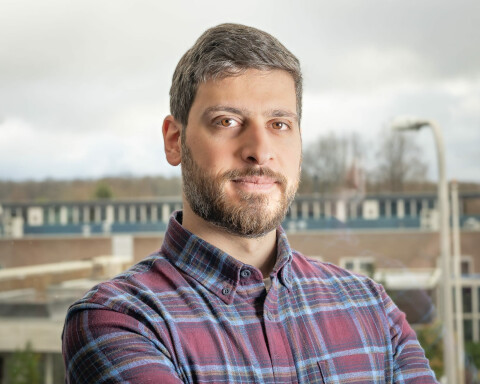
The stories Ramy Weiss (33) from Syria heard about finding work in the Netherlands were sometimes discouraging. Yet he has now found a job as an engineer. The same profession he had in Syria. “As a refugee, you are just as capable of working as someone from Europe.” Judy Karajoli of RFG Magazine spoke with Ramy about his experiences, commissioned by RefugeeHelp.
When Ramy applied for asylum in the Netherlands in September 2021, he had a clear plan in mind to get his life back on track: working with the degree he had already obtained in Syria. He didn't want to start completely from scratch. “I was 30 years old and didn't have time to start a new course of study,” he says. Before leaving Syria, he called friends who were already living in the Netherlands and asked about working in the Netherlands and Dutch culture. “The stories I heard were sometimes discouraging and sometimes actually hopeful.”
Recently, Ramy was offered a contract at an engineering firm in Oldenzaal. “The fact that I succeeded shows that a lot is possible for us. As a refugee, you are just as capable of working as someone born and raised in Europe. The only barrier is the language.”
Finding a job that matched my education was difficult.
Ramy sees that the municipality can play an important and positive role in finding a job. When you have just moved to the Netherlands, you are dependent on the municipality. That is why having a good relationship with your job coach is very important. When he moved to Borne, he found volunteer work at a football club through a volunteer he knew at the asylum seekers' centre. “I mentioned that to the municipality. They were happy that I was active and took the initiative myself,” he says.
Ramy also continued searching for a suitable job. He kept an eye on the website Indeed.nl and kept applying. “There were many practical jobs, but finding work as an engineer was difficult. I was invited for an interview once. The employer said I was welcome. But after a few months, he indicated that it was over for me, even though I had the potential to advance. Still, I greatly appreciated his honesty and advice.”
I have enlisted the help of an employment coach from the municipality.
When Ramy saw a vacancy that suited him as an engineer, he enlisted the help of his career coach and asked the municipality to mediate. “She contacted the company and presented me well. As a result, I got an interview. I spoke Dutch during the interview. They were happy with that. They felt that my degree was suitable for working for them.”
The job started as an unpaid work experience placement. Nevertheless, Ramy was very enthusiastic. “It was a chance for me to prove myself. I was given a three-month trial period. But after just over two months, I was already offered a contract.” The unpaid work experience placement was converted into a paid job after just a few months.
My network gave me many tips
Doing unpaid and volunteer work can have many benefits for you as a newcomer, Ramy observes. “The most important thing is networking,” he says. “I met many people in my area. They gave me tips during my job search, such as registering with an employment agency.” Ramy sees that a good network is something newcomers often lack. “You can’t live in isolation here. You need people to teach you how things work.”
Occasionally, Ramy interprets at VluchtelingenWerk Nederland (VWN) for people who do not speak English or Dutch very well. “I happened to mention to an acquaintance there that I needed a laptop to learn Dutch. That person told me about an organization in Hengelo that arranges free laptops for people who need them. It is a small organization of people that you cannot easily find if you Google ‘free laptops’. Without this tip, I would never have known about it.”
In the Netherlands, the atmosphere in the workplace is much friendlier.
Ramy notices that there are cultural differences between the Netherlands and what he was used to in Syria. “Dutch people sometimes get stressed at work, but what is considered stressful here is very different from what we are. I think that we as Syrians are very stress-resistant because of everything we have been through.”
In Homs, he worked eight hours a day at his computer and couldn't just chat with his colleagues. “If you got caught, you immediately received a warning email.” Here, according to him, the atmosphere is much friendlier: “The boss is approachable and human. The Dutch can have a nice chat during breaks as a team. That recharges you and gives you a good feeling when you get back to work. You don't work for someone, but you work together. That is really beautiful.”
Read the full article on the RFG Magazine website. Since 2017, RFG Magazine has been guiding journalists with a refugee background on their path to a stronger position in the Dutch labor market.
This article was commissioned by RefugeeHelp and previously appeared on the website RefugeeHelp.nl.