October 21st 2025
Status holders enthusiastic about work in the energy sector
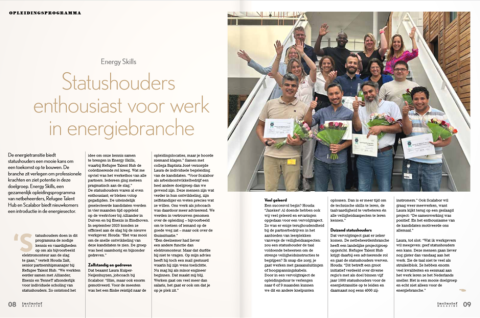
The energy transition offers refugees with refugee status a great opportunity to build a future. The sector is in need of skilled professionals and sees potential in this target group. Energy Skills, a joint training program by grid operators, the Refugee Talent Hub, and Scalabor, offers newcomers an introduction to the energy sector. Inclusie Magazine, about inclusive entrepreneurship in Central Gelderland, interviewed our colleague Houda Zaït and Laura Kuiper-Neijenhuyzen, a job coach at Scalabor.
"In this program, refugees acquire the necessary knowledge and skills to work as electricians, for example," says Houda Zaït, senior partnership manager at Refugee Talent Hub. "We previously collaborated with Alliander, Enexis, and TenneT separately to provide individual training for refugees. That's how the idea arose to combine our expertise in Energy Skills, with Refugee Talent Hub taking on the coordinating role. What struck me was the work ethic of all the partners. Everyone immediately got to work pragmatically."
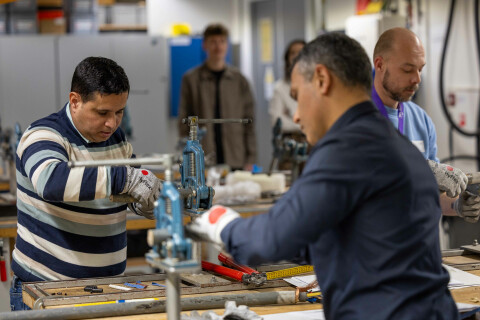
The refugees with refugee status were equally enthusiastic; there were plenty of applicants. The candidates ultimately selected were trained on the job for four months at Alliander in Duiven and at Enexis in Eindhoven. They were officially able to start working for their new employer in September 2025. Houda: "It was wonderful to see the rapid development of these candidates. The group was very cohesive and exceptionally driven."
Independent and driven
Laura Kuiper-Neijenhuyzen, a job coach at Scalabor, agrees: "Smart, but also incredibly motivated. For most, it was a considerable commute to the training locations, but you didn't hear anyone complain." Together with her colleague Baptista José, Laura provided individual guidance to the candidates. "For Scalabor, as a career development agency, this is a very different target group than we're used to. These people are further along in their development, more independent, and know exactly what they want. Our work as job coaches was therefore more advisory. We were consulted about the training—for example, to assess whether someone was on the right track—but also about their home situation."
One participant preferred a position other than electrician. But he didn't dare ask. On my advice, he sent an email explaining his request. Now he can start as a minor engineer. That makes me happy. Work is about much more than just a salary; it's also about being in the right place.
Learned a lot
A successful start? Houda: “Absolutely! We've also learned a lot and gained experience for a follow-up program. For example, there was some reluctance among the partner companies to offer apprenticeships due to safety concerns: would a status holder have sufficient command of the language to understand the strict safety instructions? I understand that concern; you'll be working with gas connections or high-voltage cables. By extending the training period to 6 or 9 months in a follow-up program, we can address this and other issues. This will allow more time to acquire technical skills, improve language skills, and familiarize yourself with all safety aspects.”
A thousand status holders
That follow-up project will definitely happen. The grid operator sector has established a national project group. The Refugee Talent Hub will play an advisory role and will recruit the refugees. Houda: "This is a large-scale initiative spread across various regions, with the goal of training 1,000 refugees for the energy transition within five years, as well as another 4,000 lateral entrants." Scalabor is also eager to participate again, as Laura looks back on a successful project: "The collaboration was positive. And the candidates' enthusiasm motivated us all."
Laura, finally: "My advice to employers: give refugees with refugee status a chance. These people would rather start working sooner rather than later. Don't see language as a stumbling block. They have a wealth of talents, and once they start working, they'll learn Dutch faster. They're a great target group, and definitely not just for the energy sector."
View the article in Inclusief Magazine
Status holders enthusiastic about work in the energy sector , Inclusief Magazine 2025, pp 6-7
Or read more: