March 30th 2026
The different language levels
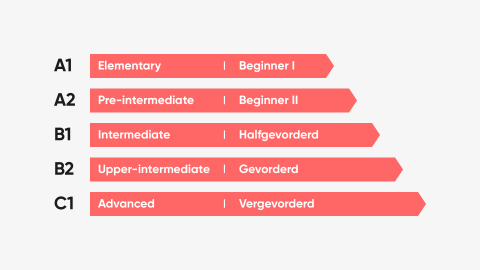
Language levels according to the CEFR (Common European Framework of Reference for Languages) There are six CEFR language levels. From lowest to highest, these are A1, A2, B1, B2, C1 and C2. The framework was developed to help describe a person’s proficiency in a foreign language. Below, you can find an explanation of what each level means.
You can indicate your level of proficiency in a foreign language using the framework established by the Council of Europe: the Common European Framework of Reference for Languages (CEFR). This classification distinguishes six language levels, ranging from A1 (lowest level) to C2 (highest level). These levels evaluate five skills: reading, listening, writing, speaking, and conversational interaction.
This framework allows you to assess your level in a foreign language and compare it with others on an international scale. It specifically applies to proficiency in a language other than one’s mother tongue. Note: The term B1 level is used not only to define foreign language proficiency, but also in guidelines for clear and accessible language.
From A1 to C2: What can someone do at each level?
At A1 level (basic user, beginner), you can:
- Use familiar everyday expressions and basic phrases aimed at the satisfaction of concrete needs
- Introduce yourself to others
- Ask and answer questions about personal details, such as where you live, people you know, and things you own
- Fill in personal details on a form, such as your name, address, and nationality
- Interact in a simple way, provided the other person talks slowly and clearly and is prepared to help
At A2 level (basic user, elementary), you can:
- Understand sentences and frequently used expressions related to areas of most immediate relevance (e.g. personal information, family, shopping, local geography, employment, or education)
- Communicate during simple and routine tasks, and write a short message, such as a thank-you note
- Describe in simple terms aspects of your background and immediate environment
At B1 level (independent user, intermediate), you can:
- Understand the main points of clear standard input on familiar matters regularly encountered in work, school, and leisure
- Deal with most situations likely to arise whilst travelling in an area where the language is spoken
- Produce simple connected text on topics that are familiar or of personal interest
- Describe experiences and events, dreams, hopes, and ambitions
- Briefly give reasons and explanations for opinions and plans
Non-native speakers learning Dutch as a foreign language (NT2) in the Netherlands require a B1 level to enrol in vocational or MBO education.
At B2 level (independent user, upper-intermediate), you can:
- Understand the main ideas of complex text on both concrete and abstract topics, including technical discussions in your field of specialisation
- Interact with a degree of fluency and spontaneity that makes regular interaction with native speakers quite possible without strain for either party
- Produce clear, detailed text on a wide range of subjects
- Explain a viewpoint on a topical issue, giving the advantages and disadvantages of various options
Non-native Dutch speakers generally need a B2 level of Dutch to pursue higher education at a university of applied sciences (HBO) or a research university in the Netherlands.
---
This article is sourced from Onze Taal. If you would like to know more about levels C1 and C2, please visit the Onze Taal website. The image is provided by the Language Centre at the University of Groningen.