
October 16th 2026
Finding, retaining, and growing talent: what is needed for that?
As an employer, how do you ensure that you not only find talent, but also retain it and help it grow? The Migration Advisory Council makes recommendations to better utilize the talent of migrants. Using practical examples, we show how you, as an employer, can get started with this.
In the Netherlands, much talent remains untapped. According to the Migration Advisory Council , over 330,000 more migrants would be employed if they worked as often as comparable Dutch people without a migration background. That is almost as many as the number of open vacancies.
In the new advisory letter *Investing in Untapped Talent*, the council makes recommendations to offer migrants better opportunities to find, retain, and advance in their employment. After all, work offers people opportunities to become financially independent and find their place in society. At the same time, employers can utilize knowledge, experience, and talent that often remain untapped.
At Refugee Talent Hub, we recognize many of these recommendations from our daily collaboration with employers. What do they mean for you as an employer? And how do they help you find, retain, and grow talent?
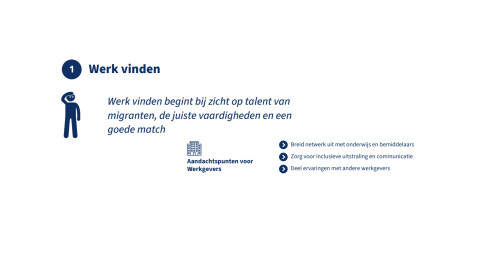
1. Finding work
Talent is available, but employers and people with a refugee background do not always find each other. Furthermore, the qualities of newcomers are not always recognized in traditional application procedures. The Migration Advisory Council therefore advises employers to actively seek contact with educational institutions and organizations, such as Refugee Talent Hub, and to structure their recruitment and selection processes more inclusively.
We saw this reflected at OMRON Healthcare. When selecting newcomers, OMRON looks not only at diplomas and work experience, but primarily at motivation, skills, and growth potential.
What can you do as an employer?
- Review job requirements critically. Also give candidates other ways to showcase their talent.
- Expand your reach. Collaborate with educational institutions and intermediaries, and learn from other employers.
- Leverage your network. Help identify opportunities and connect newcomers with others.
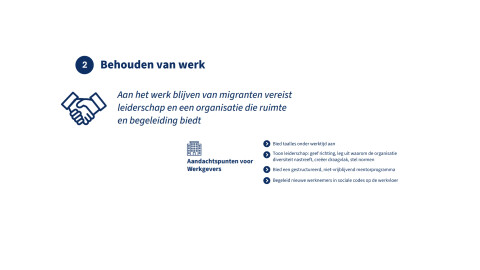
2. Keep your job
Finding a job is one thing; finding your place within an organization is at least as important. That is why the Migration Advisory Council emphasizes the importance of engaged managers, good guidance, and a work environment where everyone feels welcome and can develop. This requires something not only of the new employee but also of the team and the organization.
The story of Selim and his supervisor Nicholas at NS illustrates just how important that is. Selim works as a tester in the public transport pass team. Nicholas knew in advance that his arrival would require extra guidance. And that proved to be the case. Colleagues take the time to explain things, there is a buddy, and the team pitches in. During a meeting, for example, Selim noticed that he was unfamiliar with the expression 'samen optrekken' (working together). By asking about it, he learned something new. And his colleagues became more aware of the language they use every day.
What can you do as an employer?
- Ensure proper guidance. Pair employees with a buddy or mentor and involve the entire team.
- Provide space to learn. Open up expectations and encourage questions.
- Keep the conversation going. Learn from each other and create a workplace where everyone can develop.
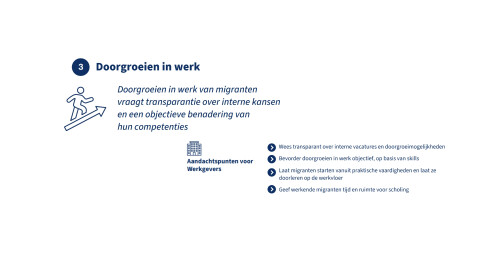
3. Career advancement
Utilizing talent also means providing room to grow. The Migration Advisory Council emphasizes that people with a migration background regularly work below their skill level. Skills and work experience they acquired previously are not always recognized or acknowledged. Therefore, the Council advises employers to prioritize skills, be clear about career advancement opportunities, and give employees the time and space to further develop themselves.
After all, suppose someone has been working for you for years and is capable of much more than the current position requires. How do you ensure those qualities are recognized? And that they know what opportunities there are for career advancement? We see how important it is to have a conversation about this. Not everyone is used to asking for a promotion or training themselves, even though someone might already bring valuable knowledge and experience that is not yet being utilized in their current role.
What can you do as an employer?
- Discuss ambitions. Look beyond someone's position or degree and discover opportunities for growth.
- Enable career advancement. Make opportunities visible and recognize previously acquired skills and qualifications.
- Provide room to learn. Invest in training, practical training, and new responsibilities.
In short, finding, retaining, and developing talent requires attention to what people are capable of and what they need to utilize their qualities. This starts with looking at talent differently, but also requires good guidance and room to grow.
Would you like to create more opportunities within your organization for people with a refugee background? Or are you curious how other employers approach this? Contact us; we would be happy to brainstorm with you.
Curious about the full advice of the Migration Advisory Council? Read it here .
Read also:
- Looking at recruitment: skills-based hiring
- SER advice: work must become the leading factor
- Checklist : Reading CVs