June 12th 2026
Start small if necessary, but start
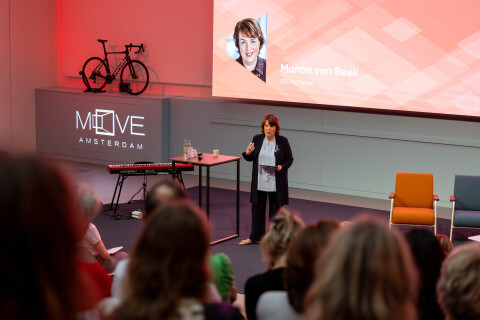
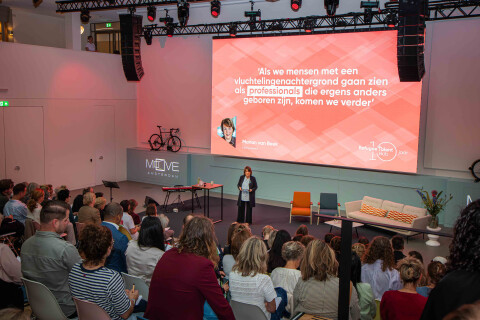
Manon van Beek, CEO of TenneT and former Chair of the Board of Refugee Talent Hub, was one of the keynote speakers at our 2026 employer event. There, she looked back on ten years of Refugee Talent Hub: the steps taken, the impact realized, and the opportunities that lie ahead.
Václav Havel once wrote that hope is not the conviction that something will turn out well, but the certainty that something is meaningful, regardless of the outcome.
When I look back on ten years of Refugee Talent Hub, I think he was right.
The start
Ten years ago, as Country Managing Director of Accenture Netherlands, I had the privilege of helping to found the Refugee Talent Hub. The reason was actually very simple. On the one hand, we saw many refugees with talent, ambition, and experience who had hardly any access to the labor market. On the other hand, like many other organizations, we were looking for talent.
It was 2015: due to the war in Syria, more than a million refugees came to Europe. It was the time of Angela Merkel's “Wir schaffen das” (We can do it). And what about us? We asked ourselves: how can we ensure that the talent coming here is utilized, that these people can build a life for themselves, and participate? And that companies gain access to all this new talent?
Wilma just discussed what the past 10 years have brought about for newcomers and for companies. What has struck me from the start is that behind the word “refugee,” or rather newcomer, hide so many different people: engineers, IT specialists, financial professionals, entrepreneurs, young talents at the beginning of their careers. People who have lost so much, but not their ambition to make something of their future.
Fast forward to now
Ten years later, more than 11,000 newcomers have participated in Refugee Talent Hub activities. A result to be incredibly proud of, and above all, proof that change is possible when companies, civil society organizations, and the government work together.
In the ten years following its founding, I had the privilege of contributing to the development of Refugee Talent Hub as Chair of the Board for eight years. I spoke with many other employers, met and welcomed newcomers at Accenture and later at TenneT as part of our partnership, and watched the Refugee Talent Hub team grow under Wilma's inspiring leadership. I saw how they transitioned from a 'project' to a start-up, and then to a scale-up. In terms of content as well. And that makes me feel good.
But what has stayed with me the most are the encounters. With Tigranne, Khaled, Isaac, Faristah, Ahmed, and Parisa, for example. The conversations with people who had to start over here. Who were learning a new language, had to build a new network, and yet kept looking for ways to contribute. That requires enormous resilience.
But I also sometimes wonder: can't more be done? Can't we all, as the Dutch employment sector, do more? After all, who could have imagined or dared to think that the reason for establishing Refugee Talent Hub is still so incredibly relevant?
This is not only a societal challenge, but also a strategic necessity. In a tight labor market, we cannot afford to leave talent untapped. Diversity is not a side issue, and inclusion is not an extra. It is a prerequisite for innovation and future-proofing. For me, one simple conviction applies: your talent passport is more important than your nationality.
Because ultimately, it is about the choice you make as a leader: do you look at rules, risks, and objections first? Or do you choose to see potential where others primarily see obstacles? That is precisely where leadership begins.
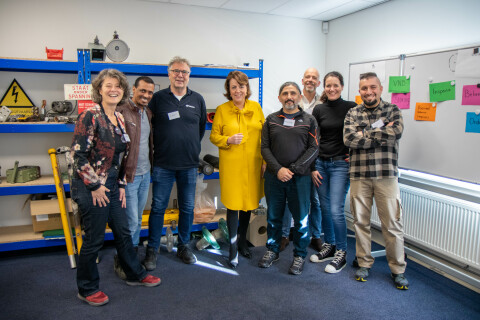
Image: Meeting with candidates during a TenneT speed date
Naturally, you hear objections: the language, the rules, the guidance. That is understandable. But often, these are primarily arguments for procrastination. Because as soon as you invest in guidance and a smooth integration into the team, it turns out that much more is possible than we often tell ourselves.
But it is possible. So many companies and entrepreneurs demonstrate that. Again today, at this event. An example that is personally close to my heart is Energy Skills.
We face an enormous challenge. For the energy transition alone, tens of thousands of additional skilled professionals will be needed in the coming years. At the same time, we see many newcomers with talent, motivation, and an affinity for technology who are eager to get to work.
In Energy Skills, those two worlds come together. Together with Refugee Talent Hub, Alliander, and Enexis, we train status holders for a career in the energy sector. They learn technical skills, safety, technical terminology, and the Dutch work culture, enabling them to progress to positions as mechanic and technician.
To me, this program shows what Refugee Talent Hub is essentially about. Not about charity. Not about ticking off a diversity objective. But about connecting societal impact to a real economic need. About giving people opportunities and, at the same time, building the future of the Netherlands.
For we will only realize the energy transition if we know how to utilize all available talent.
What have I learned in those ten years?
- First of all: change begins with commitment. From the top, of course, but ultimately especially from the manager who decides to give it a chance. Inclusion does not take place in boardrooms, but in the teams.
- Secondly: mentoring refugee talent is perhaps the best leadership course there is. Because as soon as you mentor someone with a different background, language or path, you yourself also learn to listen, coach and lead better.
- Thirdly: inclusion must be in your strategy not only, but also in your heart. For if an initiative exists only as long as it is convenient, it will disappear at the first reorganisation or cost-cutting measure. Sustainable inclusion requires conviction.
Perhaps the most important lesson: an encounter changes perspective, and attention makes everything more beautiful. On paper, we sometimes see risks, limitations or exceptions. But as soon as people start working together, they see primarily talent, ambition and possibilities. And talent does not blossom on its own. That requires time, guidance, coordination and people who take responsibility. But every investment you make in this pays off in commitment, loyalty and new perspectives.
Those lessons tell you that it is not always easy, and doesn't have to be. They do tell you, however, that you learn a lot from them and get a lot in return.
Today we talk a lot about labour market tightness, productivity, resilience and competitiveness. Rightly so. But we must also be honest: as long as talent remains on the sidelines due to assumptions, systems or cold feet, we are missing opportunities as a country that we cannot afford.
Certainly not if we simultaneously state that we are looking for people who are flexible, resilient, can adapt quickly and are motivated to learn. For it is precisely these qualities that I see time and again in newcomers.
And we also know: when we meet someone else, we see the human being. The talent, the kindness, the strength. Real change often begins the moment people get to know each other, beyond assumptions and differences. Meeting creates connection. And that is the glue of society. This creates opportunities, trust and new perspectives for newcomers and for organisations.
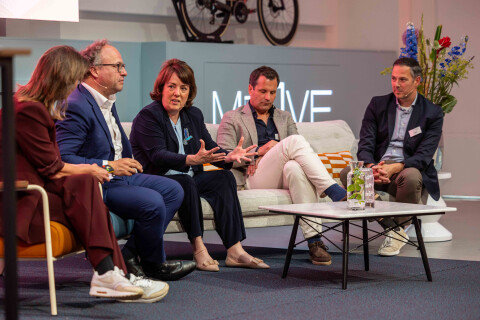
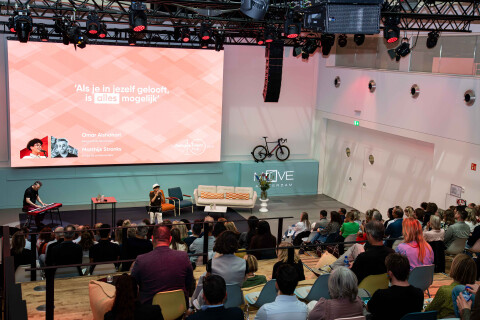
Image: Panel discussion during employer event 2026. From left to right: Wilma Roozenboom, Wouter Koolmees, Manon van Beek, Arthur Wijsmuller, Rens Wulms
The system world
And yes, of course there are challenges. Practice is sometimes stubborn. There are practical matters, laws and regulations that sometimes get in our way. The question is asked how much every euro you invest yields. But not everything of value can be immediately captured in a business case or spreadsheet.
That is precisely why leadership matters. As a leader, you have a duty not to dwell on what cannot be done, but to organise what can. And The Hague also has work to do: faster access to work, faster language learning and less bureaucratic delay. Anyone who wants to contribute should not stand on the sidelines for years.
Call
So my call is clear: do not wait. Open your organisation, your network and your perspective. Look not at origin, but at potential. Start small if necessary, but start. Because inclusion arises from concrete choices.
Ultimately, this is about a fundamental question: do we judge people by their background, or by their potential? To me, the answer is clear. Your talent passport is more important than your nationality.
If we start seeing people with a refugee background as professionals who were born elsewhere, we will make progress.
For the question is no longer whether this talent exists. The question is whether we have the courage to truly encounter it, see it and act upon it.
View the reaction of (former) Country Managing Directors Manon van Beek, Nicole van Det, and Rob Knigge here regarding the ten-year collaboration between Accenture and Refugee Talent Hub.