June 26th 2026
If one plus one is clearly three, what exactly is the problem?
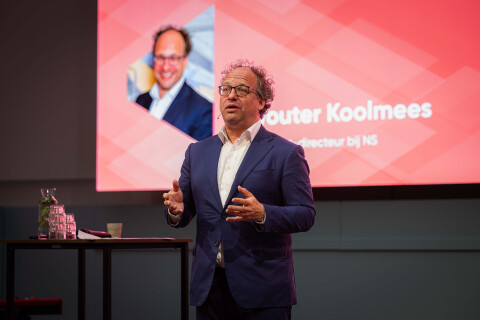
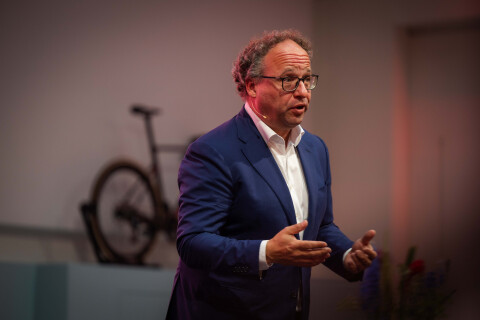
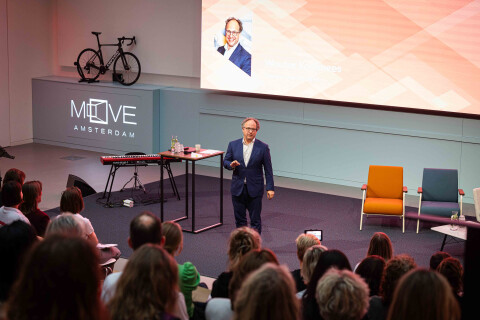
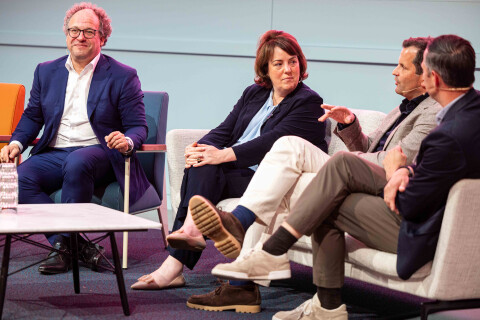
Wouter Koolmees, President and CEO of NS, was one of the keynote speakers at the employer event on 11 June. From his perspective as a citizen, minister and President and CEO of NS, he looked with us at the labour market of tomorrow.
The citizen
It seems like such a simple calculation. The labour market is experiencing a historic shortage, and we have newcomers eager to put their talents to use here. Let there be no misunderstanding: we really do need everyone. Due to an ageing population and the outflow of people retiring in the coming years, we have a significant replacement demand.
We, as in the Dutch Railways. A third of my colleagues are 55 or older. In the next ten years alone, around six thousand will retire. But also we as in the Netherlands. The issues are the same everywhere; healthcare, education, you name it.
It cuts both ways. Integration is best achieved through work. Work means integration; for starters, the income, the social contacts, the language, routine, simply getting out of the house and moving. I dare to assert that you become much happier from work than from watching Netflix all day.
But, if one plus one is so obviously three, what exactly is the problem?
Now, I don't know if politics has become more right-wing in recent years. What I do know is that the political centre has shifted recently. That means that the attitude towards newcomers has taken on a completely different dynamic. Not necessarily a positive one. Virtually all problems in this country are almost immediately – and let me be clear; almost always unfairly – linked to newcomers.
The other side is also true. I think that many Dutch people have quite a bit of understanding for people fleeing a war, for example. They understand that providing shelter is part of civilisation. That basic sense is still strongly present in the Netherlands. That offers perspective.
At the same time, in this country, we always seek reciprocity in this regard. After all, we want to have the feeling that people are doing their fair share.
When that fails to get off the ground – for whatever reason; sluggish policy is certainly one of them – then years later you suddenly do have resistance. And that makes something that seems simple suddenly very complicated. Because opponents say: "See, those people do nothing but profit." I think we have seen that image emerge over the past few decades.
The minister
In any case, I saw the picture emerge during my time as minister. In the Rutte III cabinet, I was Minister of Social Affairs and Employment. At the time, there were too few points of reference in the policy to actually do it.
Many newcomers took too long to complete their civic integration and were not encouraged to achieve the highest possible language level. Sometimes, a lower level was chosen out of a sense of security. As a result, it was difficult to truly support newcomers, and so we seemed to be slowly but surely ending up in a vicious circle. The sentiment surrounding newcomers became increasingly negative.
At my proposal, the House of Representatives therefore approved a new Civic Integration Act by a large majority in July 2020. In this new system, a higher standard applies to the language level, and newcomers immediately combine their language lessons with volunteer work or an internship.
In addition, newcomers become more actively acquainted with the local labour market. And finally, a greater role for municipalities. After all, they are the level of government closest to the people and can therefore offer the best tailored solutions.
The President and CEO
In November 2022, my role changed and I became an employer, so to speak. I started my job as President and CEO of NS. You should view NS as the Netherlands in miniature. Every national development plays out within our company as well. We are a state-owned enterprise, see ourselves as a social service provider, and are always eager to be part of the solution. At NS, we believe that equal dreams deserve equal opportunities. We believe that diversity makes us stronger. That is why, since 2015, we have been committed to offering newcomers the chance to develop their talents. To play a role, for example, in driving trains, in engineering, or within IT.
In the meantime, we have dozens of newcomers on staff. The 10 jobs for highly educated professionals that we offer annually have proven to be a stepping stone in the Dutch labour market. About 75 per cent of the participants find a suitable job at that level, either within or outside NS.
Another example we are proud of: in our own MBO 2 train mechanic programme, we have regularly had a student with a refugee background in recent years. In 2024, 10 status holders enrolled in this regular programme, joining a group of 78 students.
It is our experience that it is essential for newcomers to feel part of the team. That they are supported by managers and direct colleagues. This simply means that they are allowed to ask questions, for example. From words and expressions they do not understand, to matters such as how the performance review process works.
NS has an informal culture, a Dutch culture you could also call it. That really takes some getting used to for status holders. But as soon as they realise that everyone – hopefully right up to the CEO – is approachable, it does give them more freedom to show who they are.
Sounds good, but is everything actually going well? No. The third year sometimes proves difficult, when a newcomer realises that the match isn't optimal. But NS should also take a good look in the mirror. Sometimes we are too kind, because we want so badly to help and do the right thing.
That is noble, but not the right starting point. Hiring a newcomer really needs to be part of your policy. The successful examples are always the companies that don't "want to do the right thing", but that have a vacancy they would very much like to see filled. That is also how we try to approach it at NS.
I will wrap up. Getting newcomers to work seems logical, and it is. However, it is not always easy.
Policy can get in the way, culture can get in the way. The good news, however, is that every time it succeeds, it becomes easier for the next newcomer.
Because then we will have a better understanding of what works, and because every success story improves the general perception of newcomers. And little by little, eventually, the whole of the Netherlands will see that getting newcomers into work as quickly as possible, in every possible way, is a good idea.
That makes it worthwhile for NS to fight for this every day.
View more:
- More about diversity and inclusion at NS
- The keynote speech by Manon van Beek
- The best practice of HEMA Zutphen